

 English
 日本
日本 한국인
한국인 Français
 Deutsch
 español
 Italiano
 Portugal
 Việt Nam
 türkiye
 عرب
عرب Русский
 čeština
 แบบไทย
 Eesti
Eesti Gaeilge
 Hmoob
Hmoob íslenskur
 Cymraeg
 български
 اردو
اردو Polski
 Hrvatski
 українська
 bosanski
 فارسی
فارسی lietuvių
 latviski
 עִברִית
 Română
 Ελληνικά
 dansk
dansk Magyar
 norsk
norsk Suomalainen
 Nederlands
 svenska
 slovenský
 Slovenščina
 हिंदी
हिंदी Indonesia
 Melayu
 Malti
Malti Kreyòl ayisyen
 català
 বাংলা
বাংলা Српски
 o'zbek

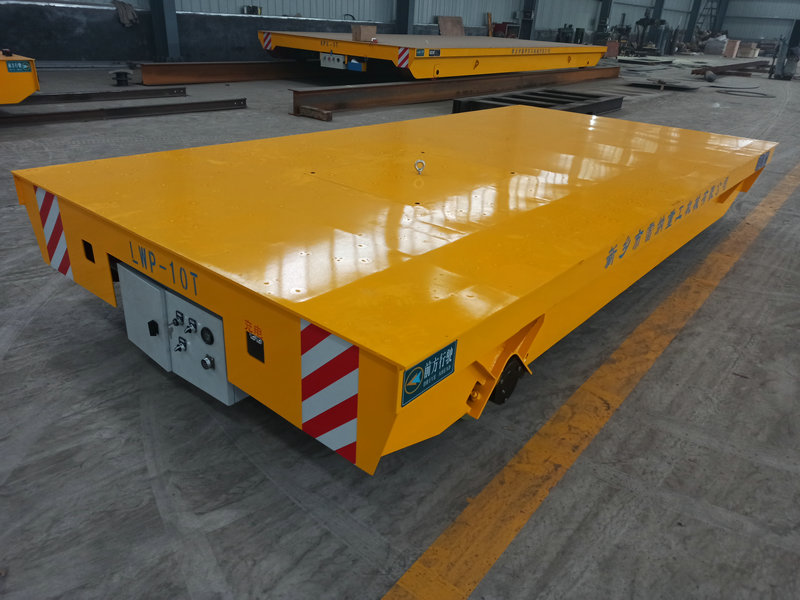
Trackless electric transfer carts are a modern transportation device widely used in industry, warehousing, logistics, and other applications. They offer advantages such as ease of operation, safety, reliability, environmental friendliness, and energy efficiency, providing businesses with an efficient and low-cost material handling solution. Below is a detailed introduction to the features, structure, working principle, and application areas of trackless electric transfer carts.
I. Features
1. High Flexibility: Trackless electric transfer carts are not restricted by tracks and can travel freely on any surface, meeting the needs of various complex scenarios.
2. High Load Capacity: Depending on the model and configuration, the load capacity of trackless electric transfder carts can reach tens or even hundreds of tons, suitable for handling large materials.
3. Environmentally Friendly and Energy-Saving: Powered by batteries, they produce no pollution emissions, reducing operating costs for businesses and contributing to environmental protection.
4. Easy Operation: The user-friendly interface allows operators to control the transfer cart with only simple operating skills.
5. Safe and Reliable: Equipped with multiple safety protection devices, such as anti-collision and anti-slip devices, effectively ensuring the safety of operators and equipment.
II. Structure
The trackless electric transfer cart mainly consists of the following parts:
1. Carriage: The main body carrying materials, usually welded from steel, possessing good load-bearing capacity and stability.
2. Battery Pack: Serving as the power source for the transfer cart, generally using rechargeable batteries; different capacity battery packs can be selected according to needs.
3. Drive System: Includes components such as a motor and reducer, converting electrical energy into mechanical energy to enable the transfer cart to move.
4. Control System: Receives operator commands to control the transfer cart's start, stop, and direction of travel.
5. Guiding System: Responsible for controlling the transdfer cart's direction of travel, ensuring smooth movement during transport.
6. Braking System: Used to control the transfer cart's speed, including an emergency braking device to ensure the transfer cart stops quickly in emergency situations.
7. Safety Protection Devices: Including infrared anti-collision devices and limit switches, ensuring the safety of the flatcar during operation.
III. Working Principle
The trackless electric flatcar is powered by batteries. The drive system converts electrical energy into mechanical energy, propelling the cart. The operator inputs commands through the control system, enabling the flatcar to move forward, backward, turn left, and turn right. During operation, safety protection devices monitor the flatcar's status in real time to ensure safe and reliable completion of transport tasks.
IV. Application Areas
The trackless electric flatcar is widely used in the following fields:
1. Factory production lines: Used for bulk material handling, improving production efficiency.
2. Warehousing and logistics: Used for loading, unloading, sorting, and sorting of goods, reducing labor intensity.
3. Shipbuilding and repair: Used for the transportation and installation of large ship components.
4. Iron and steel metallurgy: Used for handling large materials such as steel plates and profiles.
5. Energy and chemical industry: Used for the transportation of raw materials and finished products.
6. Rail Transit: Used for the maintenance and replacement of rail transit equipment.
In summary, trackless electric transfer carts play an important role in various situations due to their flexibility, load-bearing capacity, and energy-saving features. With continuous technological advancements, trackless electric transfer carts will become more intelligent and automated, creating greater value for businesses.